No Users to Ask. No Precedent to Follow. A New Category to Design.
Product Strategy
Enterprise SaaS
Revenue Growth
Context
In early 2025, our CEO mentioned a company called Profound. They had just gotten funded, and they were building something nobody had built before: a platform to help brands monitor their presence in AI-generated search results. Nobody at Writesonic had heard of it.
At the same time, our core features -- article writing, site audits -- were getting easier to replicate. Claude and ChatGPT were catching up. Dozens of other tools were offering similar things. We needed a moat.
GEO (Generative Engine Optimization) was that moat. The question was: how do you design a product for a category that barely exists?
72% of AI platform users rely on AI as their primary tool for researching products and brands
Adobe, 2025
Role
The product team brought the idea. I was brought in to figure out the reporting and metrics side. What data does a user actually need for something they have never seen before? What does "good" even look like in AI search?
User research, usability testing, user flows, wireframes, prototyping, and impact tracking. 12 weeks.
Our process was messy but quick. We used AI platforms like Claude and V0 to prototype and dive deep into what the future of GEO might look like—not just the current state of competitors, but what a mature enterprise GEO platform could be. Think Ahrefs and Semrush, but for GEO.
How do we get AI visibility data?

When you can't ask users what they want
Challenge
I couldn't do traditional user research. GEO didn't exist as a category, which meant users had no mental model for what they'd want from it. Asking them was like asking someone in 1998 whether they'd pay for cloud storage. There was nothing to react to, no learned behavior to probe.
Solution
I found the closest analogue: SEO. I studied how Ahrefs and Semrush structured metrics, reports, and user progression. I read AI citation research papers to ground the numbers in evidence. I used Writesonic's own early product usage to pressure-test what felt meaningful vs. noise.
The core metrics
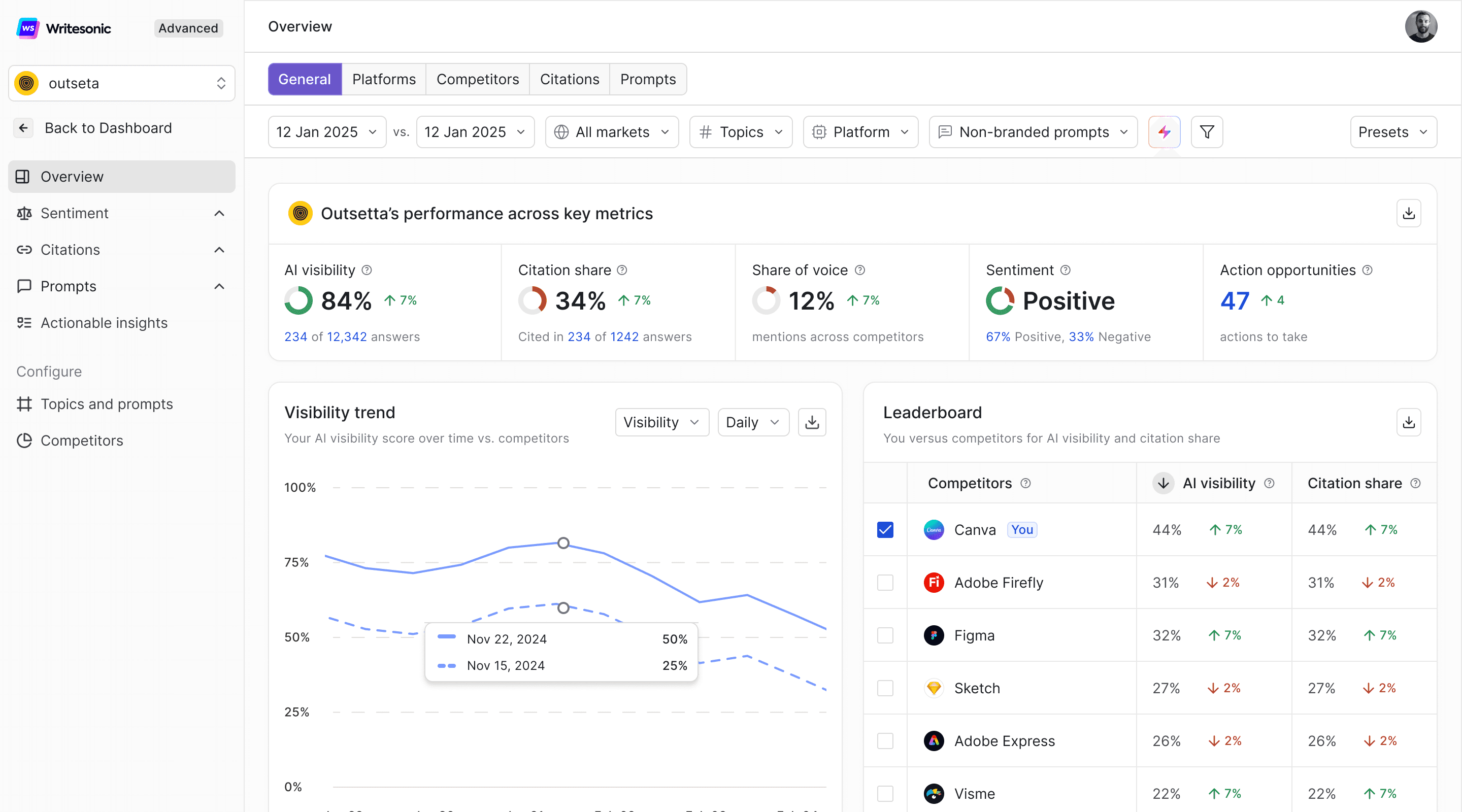
AI Visibility
How often your brand appears in AI-generated responses
Citation Share
What percentage of AI citations link to your content vs. competitors
Share of Voice
Your brand presence across AI platforms vs. the competitive set
Configure your competitors and prompts
Set up what you want to track and who you're competing against.
Track AI visibility and citations
See citations, prompts, and answers across ChatGPT, Perplexity, Gemini, and Claude.
Sentiment analysis
Get data on how AI is talking about your product - positive, negative, or neutral.
Progressive disclosure
High-level reports for quick insights, with the ability to drill down into responses for deeper analysis.
From wrong turns to the right calls
Challenge
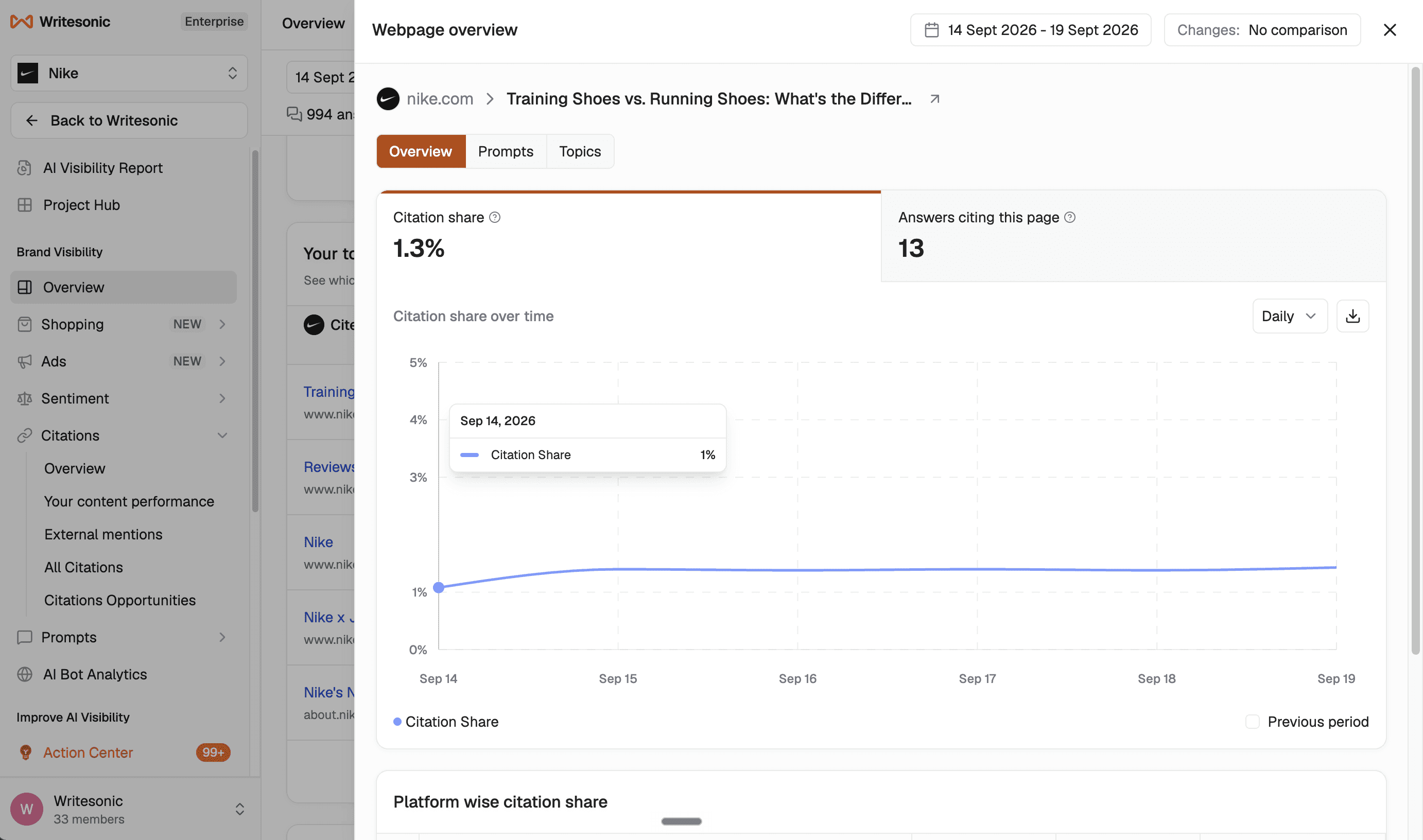
When a user clicked on a data point to investigate, the default plan was to redirect them to a separate report page. On paper, that's straightforward routing. In a monitoring tool, it's a problem.
You're watching multiple metrics at once, looking for what shifted and why. Every redirect broke that. Users lost their benchmark context.
Solution
I proposed a side drawer: detail content loads in a panel while the dashboard stays visible behind it. I built two prototypes and ran testing with users on the same task: find why a specific AI citation dropped last week. Most users preferred the side drawer because it was intuitive and displayed all required information on one page.


After Version 1, we waited for feedback from the sales team, customer success, and keeping an eye on the GEO horizon for the latest changes.
A pattern appeared in user feedback: "Great, I can see my AI visibility score. But how do I actually improve it?". The dashboards told users where they stood. They had no answer for what to do next. That feedback directly shaped Phase 2.
Phase 2
Action centre
We used AI to make it as easy as possible for the end user to take action. The Workflows feature is a testament to that. While other competitors are building complex node-based workflows, we took a chat based approach inspired from tools like Claude Code and Open Claw.
Boost AI Citations
Create new, high-authority articles specifically designed to be "picked up" and cited by LLMs.
External Authority Building
Identify and reach out to relevant blogs or engage in Reddit communities to secure brand mentions in
the places AI models crawl most
Content Refresh
Instantly update your existing web pages to make them more "AI-friendly" and readable for
generative crawlers.
Competitor Intel
Analyze exactly why your competitors are winning AI citations and generate a plan to bridge the gap.
Technical Health Check
Automatically find and fix hidden technical issues, like robots.txt files that are accidentally blocking
AI bots from seeing your site.
Impact
GEO became one of Writesonic's fastest-growing products—and a competitive advantage.
We started closing five-figure deals with enterprise customers. Marketing agencies and Fortune 500 companies like Amazon, Unilever, Zoho, and Acer came on board. These weren't just sales—they were validation that we'd solved a real problem.
The team expanded to support the growth. New customer engineers, and customer success folks joined to scale what we'd built.
Reflection
Teamwork shined here
Without the product vision, the engineering team's experiments to stubbornly work on a UX-friendly product, and the sales and CS teams' constant feedback—none of this would be possible.
I learned that a solid feedback loop is so important at every stage: discovery, design, and development.
Product thinking
I learned to not just focus on what other competitors are doing, but to think deeply about an industry and look beyond it into the future.
GEO isn't just about tracking AI citations. It's about understanding where search is going and helping brands stay ahead.